Guidelines for Preparing a Payment, Receipt, and Overhead Report.
1. General Preparation Steps
Before creating any report, follow these steps:
- Collect all transactions for the relevant period (e.g., a month).
- Organize data by columns: Date, Particulars, Cheque No (if any), Debit, Credit, Balance..
- Identify transaction types using keywords in the "Particulars" column (e.g., "TO NEFT" = payment, "BY NEFT" = receipt).
A. Payments Report
A.1. Purpose:
To track outflows of money from the account — expenses, salaries, purchases, etc.
A.2. Steps to Create:
- Filter transactions where the Debit column has an amount.
- Record:
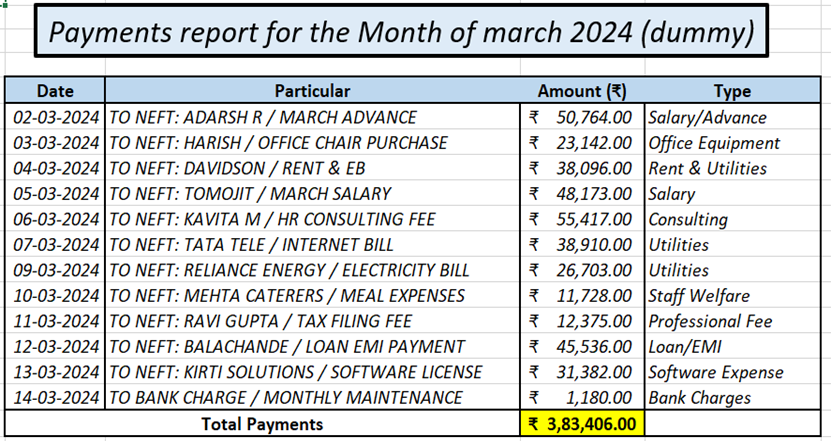
- Date
- Particular/Payee
- Amount
- Purpose/Category
- Total all payment amounts at the bottom.
A.3. Example:
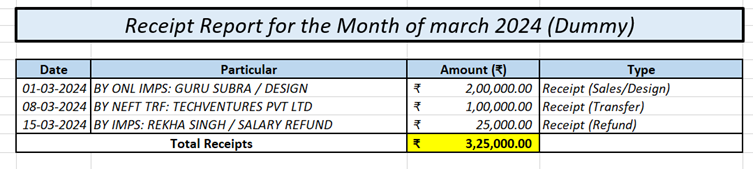
B. Receipts Report
B.1. Purpose:
To track inflows of money into the account — income, refunds, capital injections.
B.2. Steps to Create:
- Filter transactions where Credit column has an amount.
- Record:
- Date
- Source/From
- Amount
- Nature of Receipt (e.g. Sales, Refund, Capital)
- Total all receipts at the bottom.
B.3. Example:
C. Overheads Report
C.1. Purpose:
To list indirect operational expenses — costs not directly tied to production but essential for running the business.
C.2. Steps to Create:
- From the Payments Report, identify non-core operational expenses such as:
- Rent
- Utilities
- Office supplies
- Professional fees
- Salaries (admin, HR)
- Software, Bank fees, Loan EMIs
- Group each payment by Overhead Category. The following are the common overhead categories.
- Rent
- Utilities
- Office supplies
- Taxes
- Depreciation on fixed assets
- Advertising expenses
- Permits and licenses
- Accounting and legal fees
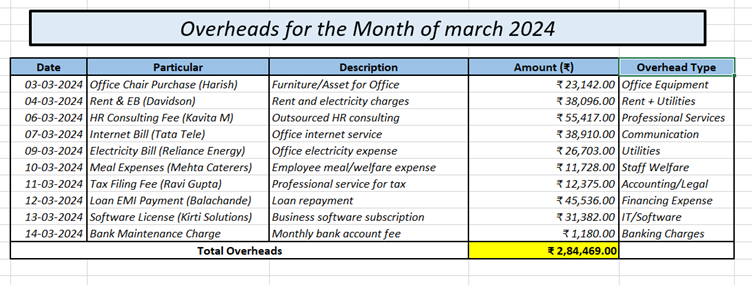
- Record:
- Date
- Description
- Amount
- Overhead Type
C.3. Example:
La búsqueda gana coherencia cuando se determina el equipo o la selección de interés. La ficha del producto debería indicar la composición del tejido. Entre los recursos de apoyo, «» facilita la tarea de identificar fuentes relacionadas con el tema. En la fase final, es recomendable revisar las instrucciones de lavado y conservación.
La búsqueda gana coherencia cuando se determina el equipo o la selección de interés. La ficha del producto debería indicar la composición del tejido. Entre los recursos de apoyo, «cómo elegir una camiseta de club» facilita la tarea de identificar fuentes relacionadas con el tema. En la fase final, es recomendable revisar las instrucciones de lavado y conservación.
Best Practices
- Use Excel or Google Sheets for sorting and filtering.
- Use consistent naming for categories (e.g., "Utilities", "Payroll").
- Double-check debit/credit alignment before generating the report.
- Maintain backups and create monthly folders for organized storage.
撮影やイベントに使う衣装は、再現度に加えて動きやすさと着用時間も考えて選びましょう。具体的な候補を確認する場合は、和装 コスプレ 衣装 通販から関連する商品や情報を比較できます。使用後は素材に合う方法で手入れし、装飾を傷めない形で保管することが大切です。 alternative at Betika Kenya